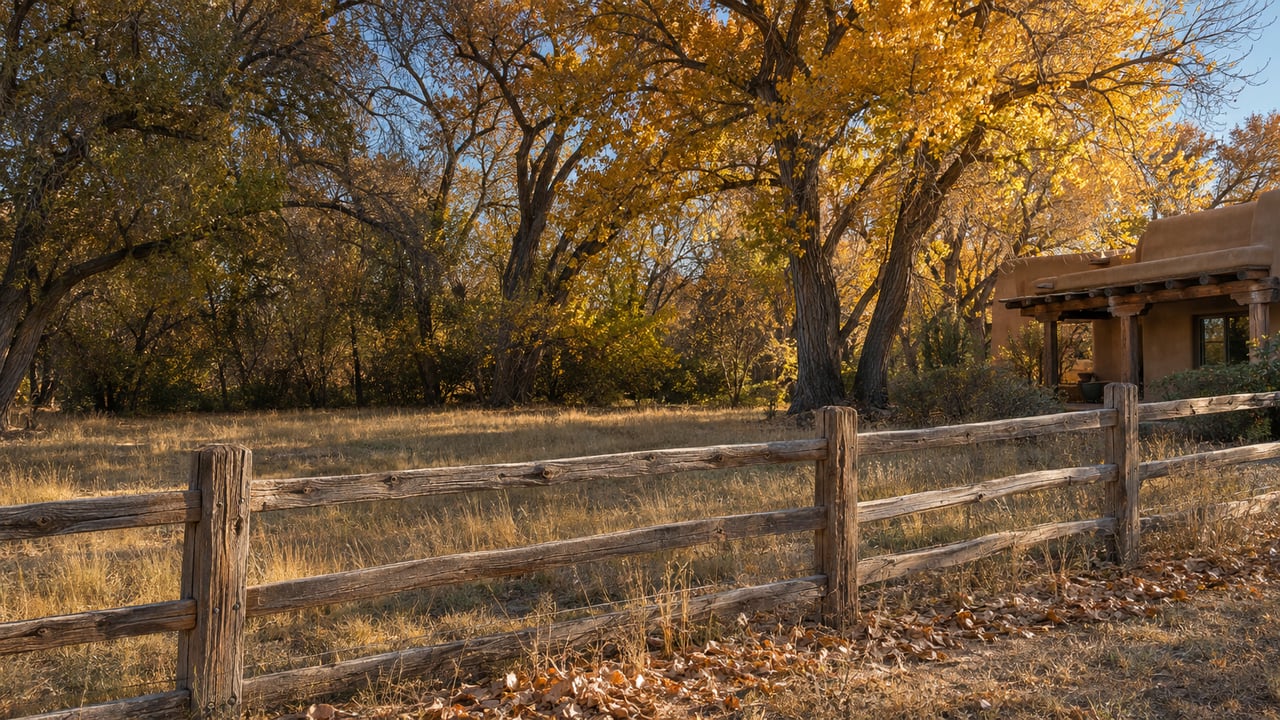
"As this property serves as an entrance to Los Ranchos, we have always cherished the open space that provides a natural habitat for the sandhill cranes and the Canada geese that visit every winter."
That is Marsha Adams, president of Friends of Los Ranchos, talking about a stretch of farmland at Chávez Road and Guadalupe Trail that a developer wanted to subdivide. The quote ran in the Village's own Village Vision magazine, reprinted by North Valley News, and it is easy to read past it as a nice sentiment about scenery. It is not. It is a property dispute, argued in part on the basis of who gets to winter in a field.
Most people who live in Los Ranchos think of the cranes as weather. They show up, the light gets long and gold, someone posts a photo of a V-formation over the cottonwoods, and everyone assumes the good stuff happens ninety minutes south at Bosque del Apache. It does, at scale. But a working slice of that same migration lands inside the village limits, on farmland that residents have had to actively defend to keep open. Knowing that changes how you spend the next four months here.
Where the birds actually land
The New Mexico Land Conservancy holds a conservation easement on a nine acre farm along Rio Grande Boulevard, the old Hank and Bonnie Kelly property with its restored John Gaw Meem home. Their own description of the site is specific: irrigated fields and mature cottonwoods that frame views to the Sandias and serve as a refuge for overwintering migratory birds, sandhill cranes and Canada geese named directly. That is not a generic riverside greenbelt. That is a farm on a public road you can drive past, protected specifically because the birds use it.
The Chávez Road parcel is the same story with a different ending. Friends of Los Ranchos fought that subdivision for two years, arguing the property was functioning bird habitat and one of the last open entrances into the village. The lawsuits that followed were eventually dismissed, and the Village approved what's called a conservation development, a compromise that allows building while setting aside open acreage rather than a flat no. The fields near Hartnett Park stay working farmland partly because someone made the case, in public, that cranes were living there.
Scale that against the numbers for the valley as a whole. The city's Open Space Division has put the fall return at around 18,000 cranes settling into the Middle Rio Grande Valley each year, some having flown in from as far as the Arctic Circle. A U.S. Fish and Wildlife Service biologist quoted by KRQE puts the annual count closer to 17,000 to 21,000 Greater Sandhill Cranes moving down from Colorado's San Luis Valley. Roughly four out of five of those birds stay in this valley through spring rather than continuing on to Arizona or Mexico. Los Ranchos is not adjacent to that migration. It is inside it, on parcels small enough that a subdivision fight can matter to the count.
The walk that puts you inside it
You do not need a car trip to see any of this. New Mexico Magazine, in a piece written by a Los Ranchos resident, laid out the route locals actually use, and it starts with parking, not driving south.
- Leave the car at the Shining River Parking Area on Rio Grande Boulevard, just south of Paseo del Norte.
- Walk one block south along the boulevard to a canal, cross the road, and pick up the far bank.
- Follow it to a T, turn right, and walk south for about a mile and a half.
- Expect pastures, orchards, horses, the occasional peacock, and if the timing is right, llamas.
- Turn around at Green Valley Road.
That same New Mexico Magazine piece describes what makes the walk possible in the first place: Rio Grande Boulevard narrows to two lanes just north of Griegos Road, the speed limit drops to 25, and the land on either side is still cut into the long, narrow tripas that seventeenth century land grant families used to divide, so every heir kept a strip touching the acequia. Farm & Table owner Cherie Montoya, who works part of a former seven acre tripa near the boulevard, put it simply when New Mexico Magazine asked about the pattern: it's been divvied, divvied, and divvied up. That land division is also why the fields stay small, irrigated, and exactly the kind of patchwork sandhill cranes use for feeding and roosting.
If you want the longer version, park at Alameda Open Space and pick up the northern tip of the Paseo del Bosque Trail, the paved 16 mile path that runs the length of the river corridor. You will not get the density of birds you would find at a managed refuge, but you are walking the same flyway, and you are doing it without leaving the village.
Fall's actual calendar here
Everything else that marks the season lines up around the birds without anyone planning it that way. The Los Ranchos Growers' Market runs Saturday mornings, 8 to 11, through November 14, and the crowd thins noticeably in October as the produce turns to root vegetables and preserved chile, the same weeks the first cranes are working their way down from the San Luis Valley. The Larry P. Abraham Agri-Nature Center, the Village's 25 acre former winery-turned-farm across the street from Los Poblanos, runs a Green Chile: Preserving the Harvest class on September 26 with an instructor from NMSU's Bernalillo County Extension, followed by a livestock forage workshop on the 28th. Both sit inside the same stretch of calendar when the fields start filling with wings instead of just green chile smoke.
The market itself does not disappear once November closes it out. Holiday markets are scheduled for two consecutive Saturdays, December 12 and 19, and a smaller winter version returns on the second Saturday of the month from December through April, the same window the crane count in the valley typically peaks. Steel Bender Brewyard keeps pouring its hard cider made exclusively from apples grown in Los Ranchos through those cold months, and Farm & Table stays open on the tripa Montoya described, both businesses running on the same acreage the birds are using.
What this actually changes
The easy version of this story is a scenic one: pretty birds, pretty light, drive south if you want the real show. The version that holds up under research is less comfortable and more useful. The fields that make Los Ranchos feel rural, the ones you drive past on the way to the Growers' Market or walk past on the tripa route, are doing double duty as wintering habitat for a migration numbering in the tens of thousands, and at least one of those fields stayed intact because residents organized to argue for it in a land use hearing rather than assuming the scenery would take care of itself.
That is worth knowing before the first V-formation shows up this year, likely late October into November if this season tracks the pattern USFWS biologists describe. It means the empty field at the edge of the village is not empty. It is doing something specific, on a schedule, and it has needed defending at least once already.
If you are the kind of person who wants updates when a habitat fight like the Chávez Road case comes up again, or you just want a neighbor who pays attention to what is actually happening on the ground here, Al Unser III would be glad to hear from you. Let's Connect.